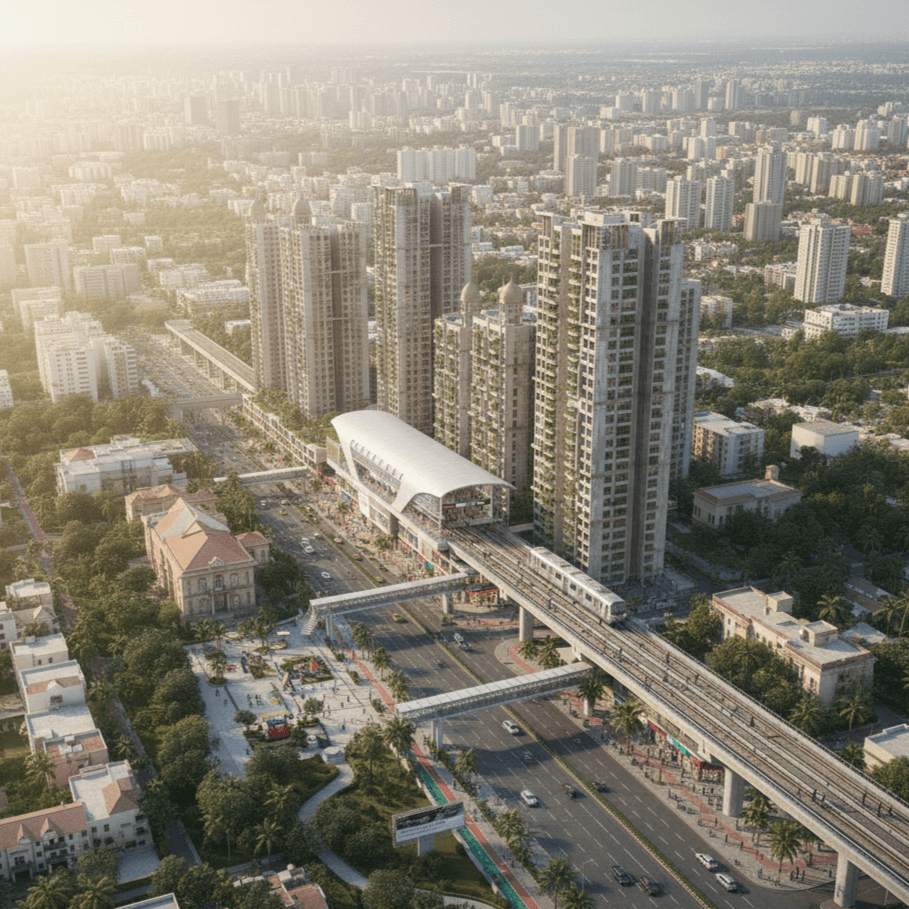
Why Transit-Oriented Development Matters Now
Union Minister Shri Manohar Lal, at the 18th Urban Mobility India (UMI) Conference & Exhibition 2025, underscored that the Delhi Metro Rail Corporation (DMRC) will act through its subsidiaries to support the planning and coordination of Mass Rapid Transit Systems (MRTS) across the country, reflecting a push for cohesive rapid transit networks. He also noted that transport systems like the Regional Rapid Transit System (RRTS) will be developed in other major cities to enhance regional connectivity and decongest urban cores. As cities across India grapple with congestion, air pollution, rising infrastructure costs, and declining quality of life, TOD has emerged as a powerful framework to realign urban growth with sustainable mobility. At its core, TOD promotes compact, mixed-use, high-density development within walking distance of mass transit, enabling cities to move people efficiently while reducing dependence on private vehicles.
Globally, TOD has proven its ability to simultaneously deliver mobility efficiency, fiscal sustainability, and urban vibrancy. From Hong Kong’s Rail + Property model to London’s Crossrail-funded regeneration corridors, the lesson is clear that transit works best when land use, finance, and governance are integrated.
This framing aligns with The Infravision Foundation’s (TIF) work on integrated urban transport and land-use planning, which focuses on legally empowering governance and financing structures and embedding transport infrastructure within coordinated spatial planning, rather than treating projects as standalone investments.1 2 3 4 India now stands at a critical juncture where TOD can determine whether its massive investments in metro and rail systems translate into long-term economic and environmental dividends.
Global Experience: TOD as an Economic and Fiscal Tool
International experience demonstrates that TOD is not merely an urban design concept but a financial and institutional strategy. Hong Kong’s Mass Transit Railway (MTR) remains the most widely cited example. Instead of relying on fare revenue alone, the government grants MTR development rights around stations. The resulting real estate revenues cross-subsidise both capital and operational costs of transit, allowing Hong Kong to operate one of the world’s most financially resilient metro systems.
Similarly, London’s Crossrail project leveraged Land Value Capture (LVC) instruments, including a Business Rate Supplement and development charges, to fund a substantial share of its capital cost. Tokyo, Seoul, and several cities in China follow comparable models, combining high-density station-area development with strong institutional coordination.
TIF has been working rigorously on Land Value Creation and Capture (LVCC) for infrastructure financing, showcasing that TOD-linked LVCC mechanisms can materially improve project bankability and reduce long-term fiscal stress on governments.
The core principle is that transit investment generates land value, and TOD provides the spatial and regulatory framework to systematically capture and reinvest this value, strengthening infrastructure capacity while enhancing the economic and urban vibrancy of TOD areas.
Opportunity and Risk for India
Over the last decade, India’s metro footprint has surged from about 248 km in 2014 to just over 1,013 km across 23 cities by May 2025, supported by about ₹2.5 lakh crore of investment in metro expansion.5 Annual central capital allocations for metro/urban transit have also jumped sharply (capital outlays in recent budgets rose into the tens of thousands of crores).6 Yet actual ridership often falls well short of DPR forecasts—many systems operate at only 25–30% of projected ridership, Delhi being an outlier at about 47%, producing persistent gaps between expected and realised passenger revenue.7 DMRC reported a loss before tax of ₹1,781.7 crore in FY 2023–24 and continues to rely on non-fare and subsidy support, a pattern flagged by analysts and think-tanks as a core fiscal challenge for Indian metros.8
Large sections of Indian cities continue to show disconnected land-use patterns, grow in low-density, car-oriented formats, even along expensive metro nodes and corridors. TOD is therefore essential to unlock the economic, social, and environmental returns of transit investment. However, implementation of TOD across Indian cities remains uneven, with institutional capacity and inter-agency coordination emerging as the principal bottlenecks.
Delhi as a Case Study: Ambition Meets Implementation Gaps
Delhi offers one of India’s most instructive TOD case studies. Despite operating one of the world’s largest metro systems, development around many stations remains fragmented or underutilised. While Delhi’s TOD policy was notified nearly a decade ago, execution lagged due to fragmented governance, rigid eligibility thresholds, and the absence of station-area planning frameworks. The East Delhi Hub at Karkardooma, Delhi’s first large-scale TOD project, illustrates both the promise and the pitfalls of TOD implementation. Initiated in February 2015, the project remains under construction, with online registration for its housing component launched only in October 2025, more than a decade after inception.
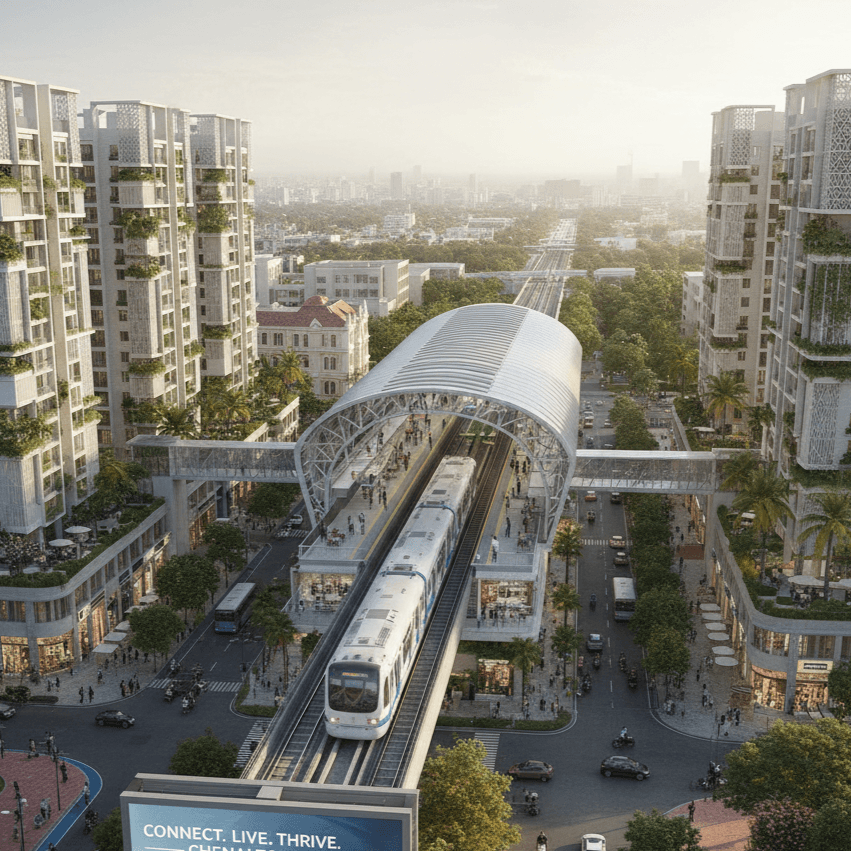
This experience reinforces TIF’s findings on implementation risk in urban infrastructure, which highlight the importance of clear institutional mandates, predictable financial rules, and synchronised planning across agencies.9
The Draft Delhi TOD Policy 2025 was placed in the public domain for objections and suggestions on 21 November 2025, against the backdrop of the DDA’s decade-long struggle to operationalise a workable and implementable TOD framework. However, a litany of concerns remains regarding the lack of operational clarity and high implementation risk. The policy provides a uniform 500 m buffer-based catchment for all TOD Nodes, regardless of whether they serve regional, city, and neighbourhood level footfalls. Network-density and walk time could be useful in delineation of TOD zones; however, even the station typology is not differentiated between Metro and RRTS. Under-sized influence zones, ridership–land-value mismatch, a flat TOD charge that disregards the value of location—these are critical issues in the draft policy. The Land Value Creation and Capture approach that IIM Ahmedabad and TIF have been developing will help cities understand that value capture is triggered by value creation in the form of planning and urban design. Undefined TOD Fund governance and the absence of a transparent mechanism of the escrow/fiduciary safeguards combine with limited stakeholder representation in the proposed oversight committee add to the risks of opacity. There is scant attention to inter-agency coordination, which is odd considering that the policy is with a ministry that promotes UMTAs. The planning and implementation risks include mono-functional development and ineffective TDR, gentrification risk, excessive parking minimums, and future transit corridors not integrated even in the notified Land Pooling Zone. Lastly, the policy lacks temporality and does not recognise the phasing gaps between infrastructure creation and monetisation of FAR.
Catchment Areas and the Economics of TOD
One of the most consequential TOD design choices is the definition of the station influence area. Global and Indian evidence indicate that 500 metres represents the most effective walkable catchment, while 800–1,000 metres functions as a secondary zone dependent on feeder services.
The economic implications are significant. A 500-metre TOD zone is effective in maximising walk-based ridership, pedestrian activity, and localised land value premiums around transit stations. In contrast, a 1,000-metre TOD zone significantly expands the development catchment, enabling substantially higher development capacity and land value creation, often up to four times the aggregate land value, provided it is supported by strong multimodal integration through feeder services, cycling infrastructure, and last-mile connectivity.
Financial and Economic Benefits Across Stakeholders
When implemented effectively, TOD delivers tangible benefits to all stakeholders. Well-designed TOD creates a virtuous cycle of benefits across stakeholders. Governments capture higher land values, generate increased tax revenues, and reduce per-capita infrastructure costs through compact urban growth. Transit agencies benefit from higher ridership, improved farebox recovery, and enhanced non-fare revenues generated through station-area development. Private developers gain access to higher FAR, premium transit-accessible locations, and strong market demand driven by improved accessibility. Most importantly, citizens experience shorter commute times, lower transport costs, better air quality, and improved access to jobs, services, and urban amenities. Empirical evidence consistently shows 10–30% property value premiums near high-quality transit. TIF’s research emphasises that even modest capture rates, if ring-fenced and transparently deployed, can meaningfully support transit and urban infrastructure financing.10 And FAR is driven by market and concentrates where the demand is, as proven in the study of a decade’s reregulation of FAR in Hyderabad. Hyderabad’s experience shows that blanket FSI deregulation can unlock density only where strong market demand and infrastructure already exist; freedom to build alone does not create vertical growth or equitable urban form. The broader lesson for India’s current push on creative redevelopment and land value capture is that FSI must be governed as a strategic lever, explicitly linked to infrastructure financing, affordable housing, and transit-oriented planning, if density is to translate into inclusive and sustainable city-building.11
What Makes TOD Work: Four Non-Negotiables
Experience across India and globally converges on four essential conditions for successful TOD:
- Integrated Governance across transport, land use, finance, and utilities.
- Clear Land Value Capture Toolkits with predictable triggers and ring-fenced deployment.
- Inclusion and Affordable Housing, ensuring TOD benefits transit-dependent populations.
- Performance Monitoring and Adaptive Policy, using indicators such as modal share, walkability, and infrastructure adequacy.
TOD as India’s Urban Growth Strategy
TOD is no longer a planning choice; it is a strategic necessity for India’s cities. As public investment in urban transport continues to scale up, TOD provides the mechanism to ensure infrastructure spending translates into economic productivity, environmental sustainability, and social inclusion.
Delhi’s evolving TOD framework, while imperfect, offers critical lessons for cities nationwide. The path forward lies not in weakening TOD principles, but in strengthening planning, financing, and governance systems so that density becomes an asset rather than a liability. If implemented with discipline and vision, TOD can help Indian cities transition toward compact, connected, and climate-resilient urban futures, where transit does not merely move people, but anchors inclusive prosperity.