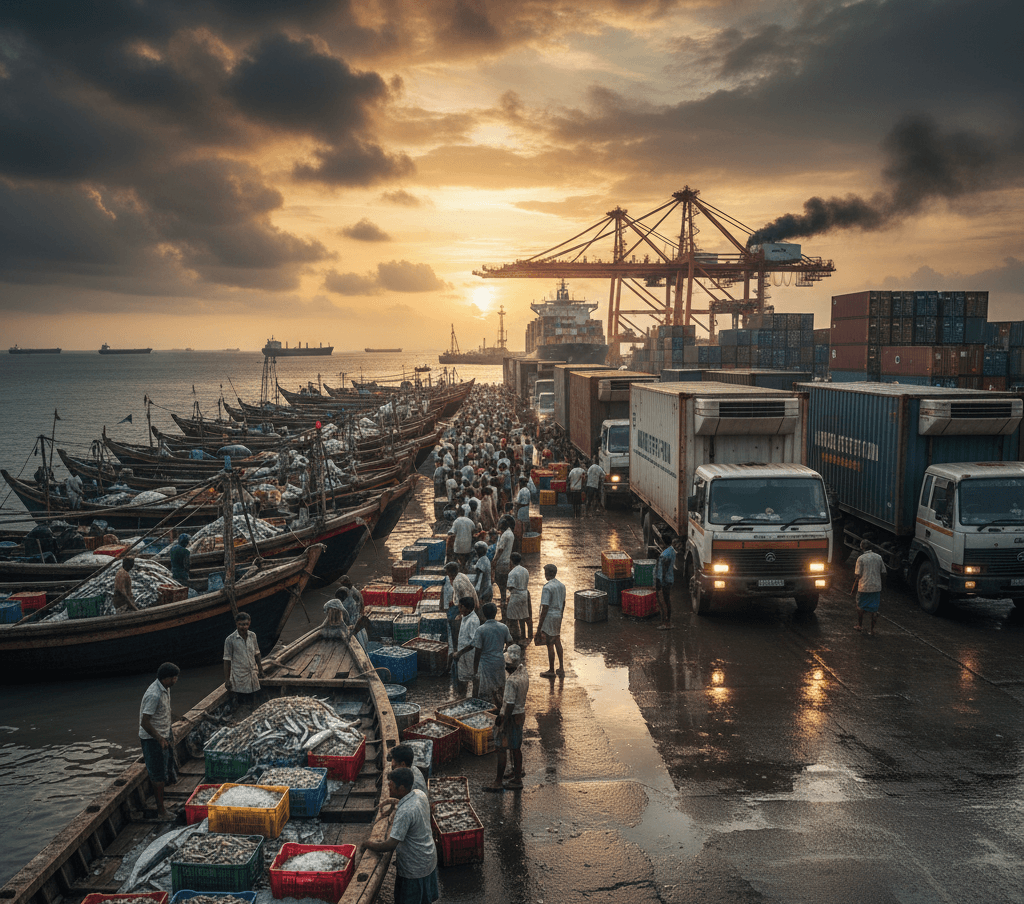
India’s marine export sector sits at a paradoxical crossroads. On the one hand, seafood exports crossed USD 7.38 billion in FY 2023-24, placing India among the world’s leading suppliers of shrimp and frozen seafood. On the other, the country’s ambition to scale exports to USD 14 billion by 2030 continues to be undermined by persistent infrastructure gaps across ports, cold chains, processing clusters, quality control systems, and last-mile connectivity1 2.
Marine exports are uniquely infrastructure-intensive. Fish is highly perishable, quality-sensitive, and export markets demand stringent compliance with hygiene, traceability, and temperature control. Any weakness, whether at the harbour, on the road, or inside a laboratory, directly translates into value loss, shipment rejection, or missed market opportunities. Despite multiple government schemes and recent budgetary announcements, India’s marine export logistics remain fragmented and uneven, creating systemic inefficiencies that constrain competitiveness.
Structural Gaps at the Point of Capture: Harbours, Vessels, and Costs
India has 7 major fishing harbours, 52 minor harbours (plus 127 major/minor harbours under development3) and more than 1,500 landing centres, yet only a limited number support mechanised unloading, hygienic handling, or scientific preservation of catch4. Most landing sites continue to rely on open-air handling, poor flooring, limited ice, and inadequate sanitation, leading to quality loss at the very first stage. Fishing harbours also face space constraints, long unloading times, inadequate cold storage, weak waste management, and a lack of proper auction and worker facilities.
These gaps are further reinforced by high operating costs and limited technological adoption. Fuel is the largest expense for boat owners, mitigated by subsidies in a few places, like in Vizag (INR ₹9/litre) and Vanakbara (VAT-free HSD) but significantly higher in centres such as Digha, where large boats incur fuel costs of nearly ₹13.90 lakh due to the absence of subsidies5. Efficiency is further weakened by limited access to modern fish-finding and vessel monitoring equipment like sonar, echo sounders, and satellite-based tracking systems. As noted by NITI Aayog, many fishermen rely on affordable Chinese instruments that lack official recognition, restricting integration with formal monitoring and safety systems. Together, these constraints reduce catch quality, depress prices, and increase rejection risks downstream6.
Port Infrastructure: Capacity, Draft, and Cold Handling Constraints
Ports remain one of the most critical bottlenecks in India’s marine export value chain. Export growth has outpaced port modernisation, resulting in congestion, long dwell times, ranging from 46 to 149 hours, and unreliable handling of perishable cargo, driven by paperwork delays, limited mechanisation, and low prioritisation of refrigerated containers7.
These challenges are amplified by India’s near-total dependence on imported shipping containers. With domestic production limited to 10,000–30,000 containers annually, compared to China’s 3 million, reefers become scarce and costly during global disruptions, exposing exporters to volatility beyond their control8.
Inadequate draft depth further constrains competitiveness. Many Indian ports cannot accommodate large container vessels, nearly 75 per cent of transshipment cargo through foreign hubs such as Colombo, Singapore, and Port Klang, increasing costs and transit times. While a few ports like Kamarajar, Paradip, and Deendayal are moving toward 18-metre drafts, and Vadhavan Port is planned as a long-term deep-draft solution, most ports remain limited to around 14 metres9.
The divergence in outcomes is evident. Visakhapatnam Port, with a 6-lakh TEU terminal, over 650 reefer points, and strong rail–road connectivity, now handles nearly 30 per cent of India’s seafood exports10 11. By contrast, many non-major ports such as Magdalla and Dahej in Gujarat suffer from operational inefficiencies. These continue to lag due to shallow berths, outdated equipment, and fragmented documentation systems12. These constraints are exacerbated by high maintenance costs, frequent equipment breakdowns, incomplete digitisation of EXIM processes, and the absence of standardised documentation, resulting in duplication, paper-heavy workflows, and avoidable delays13.
Cold-Chain Gaps: Storage, Transport, and Energy Reliability
Beyond ports, cold-chain infrastructure remains the most persistent weakness in India’s marine export ecosystem. While it spans refrigerated transport, cold storage, ice plants, and processing, each link is unevenly developed and heavily concentrated in a few coastal cities, with limited coverage near landing centres. Even where facilities exist, outdated equipment, unreliable power, and poor maintenance reduce efficiency, forcing rapid sale of catch and shortening shelf life.
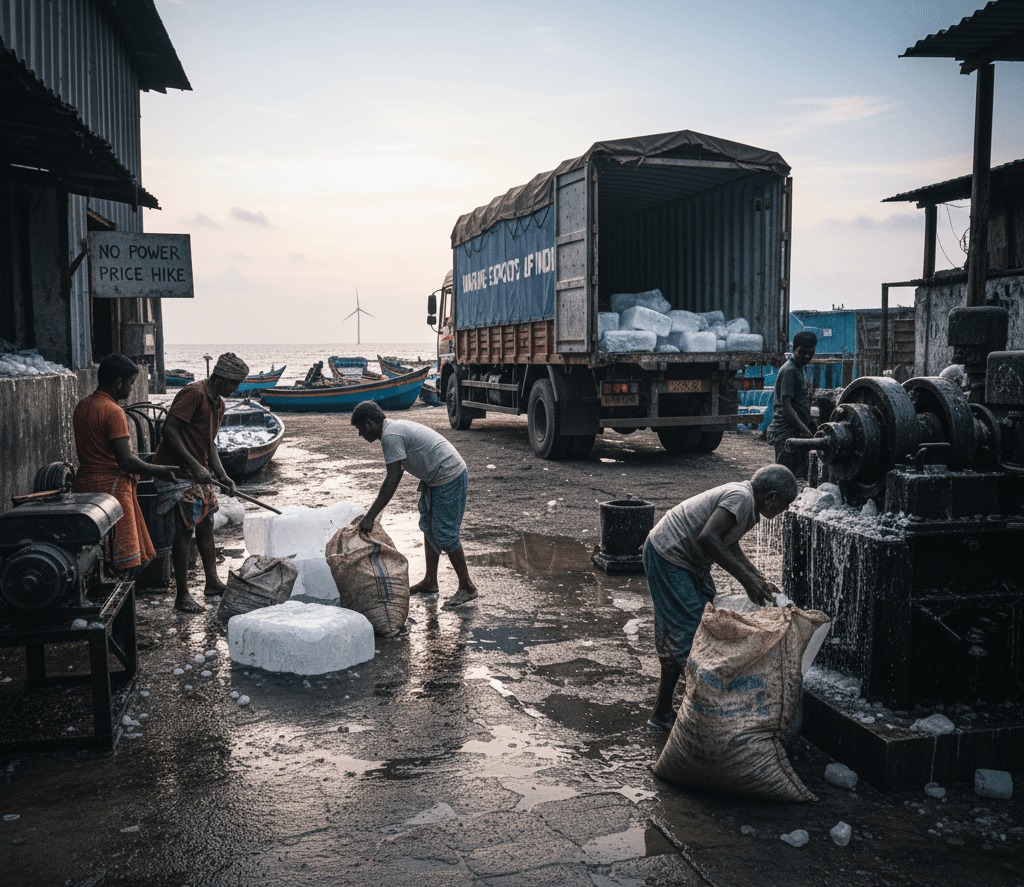
Cold-chain operations account for 20–25 per cent of total seafood export costs, driven largely by high energy, labour and maintenance expenses14. Despite significant investments under PMMSY and Fisheries and Aquaculture Infrastructure Development Fund, including support for over 27,000 ice plants and cold storage facilities, utilisation remains low15. For instance, ice plants in coastal Karnataka reportedly operate at only about 30 per cent capacity due to frequent power outages. This directly forces distress sales and quality degradation16. Rising electricity tariffs, fuel costs, and disputes over ice pricing have further disrupted supply17.
Quality risks are further compounded by untreated water used for ice production and uneven refrigerated transport, with smaller players relying on non-insulated vehicles, leading to temperature fluctuations and compliance failures.
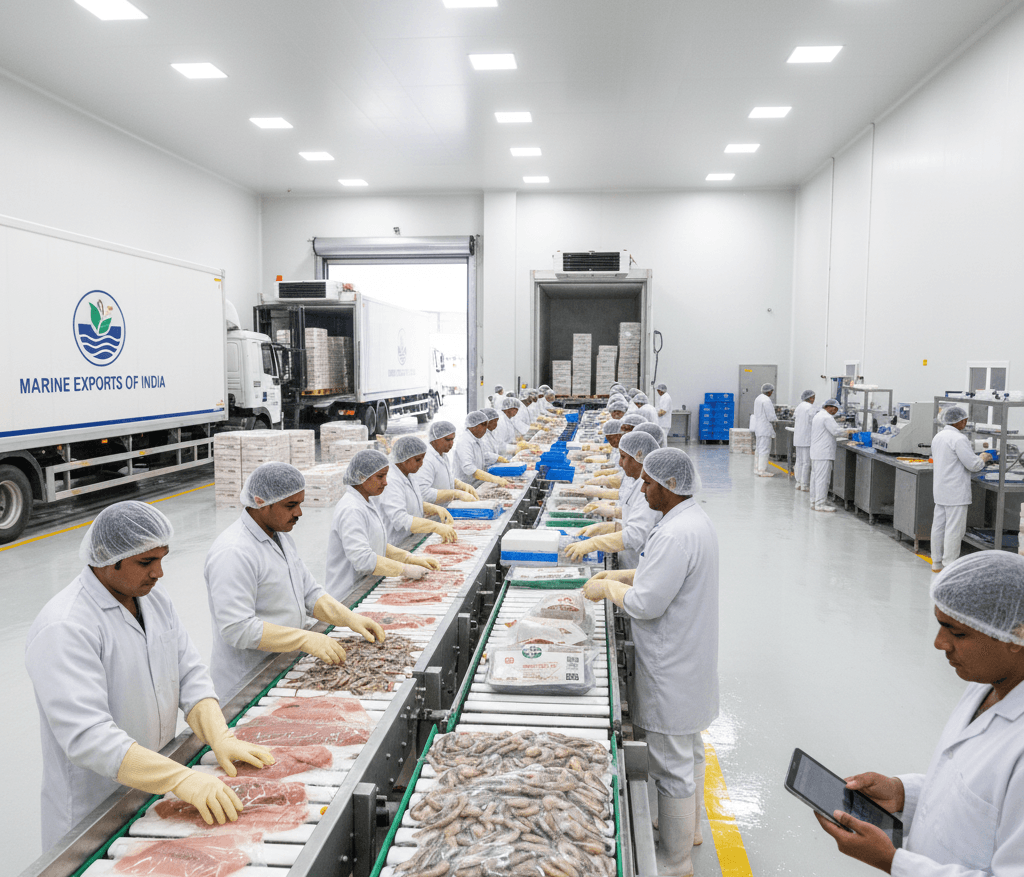
Refrigerated transport remains uneven. While large exporters operate insulated trucks, smaller players rely on ordinary vehicles packed with ice, leading to temperature fluctuations and bacterial growth during transit18.
Water, Wastewater, and Environmental Infrastructure Deficits
Water is a critical input across marine export operations, from ice production and washing to peeling sheds and processing plants. Yet untreated wastewater and contamination cost India’s fisheries sector an estimated USD 2.2 billion annually, or 5.4 per cent of its economic value19. Studies also indicate that seafood processing effluent and groundwater extraction can degrade water quality in coastal aquifers, making it unsuitable for processing without significant treatment20.
Seafood processing effluent, rich in organics, fats, salinity, and odour, is difficult to treat conventionally, and solid waste like fish scales and shells further complicates treatment. Inadequate handling contaminates coastal aquifers, forcing costly purification21. Advanced treatment solutions such as membrane filtration, biological-chemical treatment, and water reuse are essential not only for environmental compliance but also for sustaining export quality and meeting stringent international sustainability standards22.
Processing Capacity and Value-Addition Shortfalls
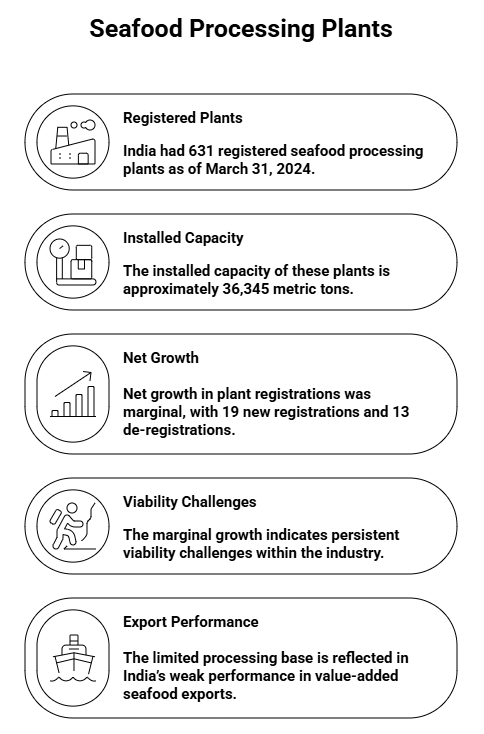
As per MPEDA’s 2023–24 Annual Report23, India had 631 registered seafood processing plants as of 31 March 2024, with an installed capacity of about 36,345 MT. Net growth has been marginal with 19 new registrations against 13 de-registrations, indicating persistent viability challenges. This limited processing base is reflected in India’s weak performance in value-added seafood exports.
Most plants remain focused on primary processing and frozen products, leaving higher-value segments such as ready-to-eat seafood, canned fish, and other processed items underdeveloped. Consequently, India’s exports continue to be dominated by frozen shrimp, while competitors like Thailand and China have moved up the value chain.
This shortfall is increasingly misaligned with rising demand in markets such as the EU, USA, Japan, and Australia for value-added products, including RTE meals, marinated and breaded seafood, canned fish, and seafood snacks. Despite being identified in export diversification strategies, gaps in advanced processing infrastructure, cold chains, and export logistics continue to constrain scale, particularly for small and mid-sized processors. India thus remains a volume leader but captures only a limited share of the value in global seafood trade24 25.
Quality Control, Testing Capacity, and Export Rejections
Quality-control lapses further dampen exports. Major markets like the EU and the US enforce stringent testing for antibiotics and pathogens, and Indian shrimp consignments have faced repeated rejections. In 2025, for instance, the US Food and Drug Administration refused multiple shipments, while seven containers from Odisha were rejected in Europe due to antibiotic contamination26 27.
Although India has over 240 NABL-accredited laboratories for fish testing, only a few are specialised, export-focused facilities operated by MPEDA under the National Residue Control Plan. MPEDA runs five NABL-accredited labs, which remain inadequate for servicing India’s extensive coastline. Most other accredited labs are not fully aligned with international seafood standards. Fragmented traceability systems further limit compliance, prompting moves toward a national digital traceability framework28.
Last-Mile Connectivity: The Weakest Link
The final leg from the landing site to the processing hub remains fragile. Many coastal roads are narrow, flood-prone, and poorly maintained. Island regions face infrequent shipping and limited air cargo options. While initiatives such as PM Gati Shakti corridors and perishable cargo trains show promise, integrated cold-chain corridors for marine products remain largely absent.
Conclusion
In response to these challenges, recent budgets and schemes have increased allocations for the sector. The 2025 Union Budget expanded credit access for fishermen, launched the ₹25,000 crore Maritime Development Fund, and reduced duties on key processing inputs, while PMMSY, Sagarmala, and Gati Shakti continue to support harbours, cold chains, and port connectivity. Island-focused initiatives and private investments in hubs such as Gujarat and Visakhapatnam indicate growing momentum. Yet marine export outcomes remain uneven, with fragmented execution diluting the impact of these programmes, an exposure sharpened by rising US trade tensions, higher tariffs, and stricter enforcement in key markets. This raises a sharper policy question: how can existing schemes be implemented differently so that infrastructure investments function as integrated, export-grade systems rather than standalone assets?
India now needs a second-generation reform agenda that goes beyond adding assets to fixing how the export system actually functions. This requires mandating real-time digital monitoring of reefers and cold storage at major ports, enforcing end-to-end electronic traceability from vessel to export, and piloting Marine Export Economic Zones where ports, processing units, testing labs, energy supply, and effluent treatment are co-located and jointly governed. Persistent cost and logistics gaps must also be addressed by rationalising fuel pricing across fishing harbours, incentivising domestic manufacturing of refrigerated containers, and building standardised reefer trucking fleets to reduce dependence on volatile imports and protect last-mile temperature integrity. Export policy should simultaneously shift toward higher-value seafood like ready-to-eat meals, canned and chilled premium products, by linking public support to value-added output rather than capacity creation. Finally, trade agreements must be used more strategically through regulatory equivalence, mutual recognition of testing laboratories, and trusted exporter channels, as seen in Chile and Vietnam, to cut inspection delays and rejection risks. These reforms must be underpinned by a move beyond upfront subsidies toward performance-linked financing that rewards uptime, compliance, and export outcomes.