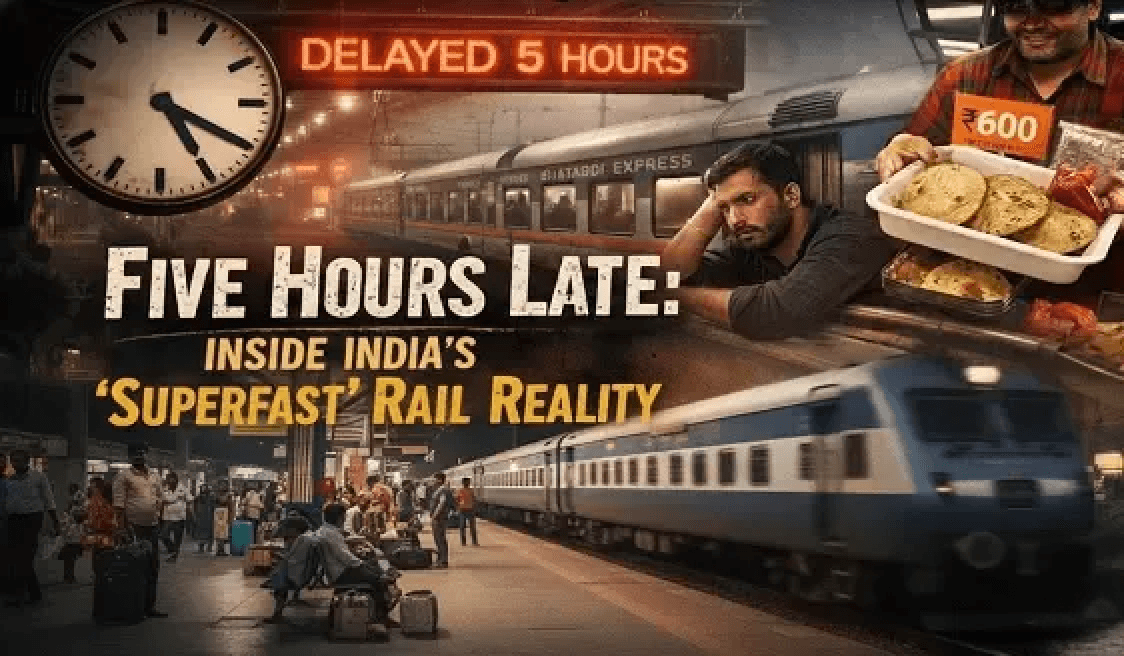
On 3 February 2026 I boarded the Hazrat Nizamuddin-Ambikapur Superfast Express (Train 22408) overnight from Delhi, bound for Sagar (Madhya Pradesh). We were in a premium AC coach (1A class, fare ₹2390) and expected a smooth 627 km ride to Sagar in about 9½ hours (scheduled arrival 08:33). Instead, the train crawled through the night and only pulled into Sagar after an extra 5+ hours of delay. This meant an actual journey time of 14½ hours and an effective speed of only 43 km/h, far below the planned 66 km/h (627 km/9.55h). Our “superfast” train performed more like a slow passenger train.
This personal ordeal highlights several systemic issues with Indian Railways: trains run much slower than promised, delays cost time and money, passenger comfort suffers, and vendors exploit stranded travellers.
Scheduled vs. Actual Speeds
By the timetable, the train should have covered 627.0 km to Sagar in about 9h33 (depart 23:00, arrive 08:33), an average speed of 66 km/h. Taking an extra 5+ hours meant 14h33 of travel, yielding only 43 km/h. This gap - one-third slower than planned - is typical of Indian long-distance trains. For context, Indian premium daytime trainsalready only 60-90 km/h even when on time. A 2016 analysis noted that even the fastest Shatabdi (Bhopal Shatabdi) tops out at 150 km/h, with average speed only 60-90 km/h. By 2021-22, Mail/Express trains targeted 75 km/h but averaged only 50.6 km/h.
Delays are also rampant. A recent parliamentary report shows on-time performance fell sharply from 90% in 2021-22 to 78.7% in 2024-25. The committee found India’s punctuality measure even ignores up to a 15-minute grace period, so actual delays may be worse.
By contrast, top rail systems run much faster. For example, Japan’s Tokaido Shinkansen averages only 1.6 minutes of delay per train. Bullet trains there routinely cruise at 300+ km/h. In India, even our experimental 130 km/h Gatimaan Express (Delhi-Agra) was nicknamed “Bullet Raja” in news reports, highlighting how far short our conventional trains fall.
Economic Cost of Delay
Every hour stranded costs money. Lost time means missed work, wasted resources, and in aggregate a drag on the economy. Long railway journeys delay goods and commuters. For freight, unreliability has driven up logistics costs: today Indian Railways hauls only 30% of the country’s freight, down from 80% three decades ago, because companies shift to road transport when schedules aren’t guaranteed. Rail freight rates in India remain about double those in China, reflecting inefficiency. Our own delay late into the morning meant losing a working day; similarly, other travellers lose meetings, bookings and wages whenever trains run late.
For passengers, paid fares feel wasted. I paid ₹2390 for first-AC service expecting a timely ride but received five hours of delay instead. (Indian Railways rules do allow full refunds if a train is over three hours late at the start station, but only if you cancel before boarding. Once aboard, there is effectively no compensation for lost time or comfort.) In macro terms, India spends 94% of IR’s revenues on operating costs and subsidies (PWC), leaving little capital to speed up tracks or add trains. This underinvestment, driven by low fares and high social spending, means the rail network is chronically over-capacity: as PwC notes, over 25% of routes run beyond capacity and half are nearly full. Bottlenecks, apart from the winter fog, such as old bridges, single lines and congested junctions force slowdowns. Every hour of delay is an economic drag: commuters face higher stress and lost productivity, and freight shipments become unreliable.
Comfort and Health Impacts
Beyond money, long travel delays harm people’s health. An 11pm boarding should have meant a restful overnight journey, but by 2am the train was still crawling through central India. Medical advice notes that “travel fatigue” can cause exhaustion, headaches, sleep loss and general discomfort.
Excessive Fares vs. Poor Service
India’s common travellers are facing not only by delays but also poor service. Paying a premium fare for a premium class, does not guarantee standard on-board services. In our case, a catering vendor boarded selling “restaurant-made” aloo-parathas (3 for ₹600!). With a promised steaming fresh paranthas, handed three stone-hard, cold pooris with scant red liquid curry. After taking the cash, he fled immediately. This kind of scam is unfortunately common on long trains. Media investigations and viral videos have exposed overcharging and even violence by unofficial caterers. For example, a 2025 NDTV report described how a pantry vendor on the Hemkunt Express was selling water priced at ₹15, at ₹20. When a passenger complained, he was brutally attacked, and only after a viral video did IRCTC cancel the vendor’s contract for five years. Similarly, a video on the Veraval-Jabalpur Somnath Express showed a passenger assaulted for objecting to an overpriced food bill. The official e-catering system and pantry cars remain missing or inconsistent.
Passengers pay high fares but frequently endure stale food, rude staff and extortionate vendors. This compounds the frustration of delays. If my ₹600 parathas are anything to judge, then ₹2390 for A1 travel, without guaranteed speed or service, feels like very poor value.
Global Comparisons
Against this backdrop, India’s railway underperformance is stark. In leading countries, on-time, high-speed trains have become routine. The Japanese Shinkansen is the gold standard: on the busy Tokyo-Osaka corridor the average delay is only 1.6 minutes per train. The entire network boasts almost 100% punctuality (even counting earthquakes). Japan’s bullet trains run regularly at 300+ km/h with top speeds up to 320 km/h, slashing travel times. Similarly, Europe’s TGV and ICE networks see over 200 km/h regular speeds with on-time percentages often above 80-90%. (By contrast, even in Japan a 15-minute delay is lamentable, in India, IR doesn’t even call 15 minutes late.)
The difference is not just speed but system design: advanced countries often have dedicated lines (separating freight and passenger traffic), automatic signalling and rigorous maintenance. Indian Railways is moving in that direction with projects like Kavach (auto-stop technology on 18,000 km) and new doubletracking, but progress is uneven. Meanwhile, ordinary travellers continue to face delays measured in hours, not minutes.
Government Plans: High-Speed Rail Corridors
Frustrated common travellers may take hope from recent policy shifts. In the Union Budget 2026 speech, Finance Minister Nirmala Sitharaman announced seven new high-speed rail corridors as “growth connectors”. These will join the under-construction Mumbai-Ahmedabad bullet line. The seven proposed routes are: Mumbai-Pune; Pune-Hyderabad; Hyderabad-Bengaluru; Hyderabad-Chennai; Chennai-Bengaluru; Delhi-Varanasi; and Varanasi-Siliguri. In other words, major city pairs in western, southern and eastern India would get 250 km/h trains. The government notes that while bullet trains run 300 km/h, these high-speed lines (technically 220-250 km/h) will enable much faster travel than current network.
For example, media analysis shows the Delhi-Varanasi trip would drop to under 4 hours, and the Mumbai-Pune run to just 48 minutes. (Compare today’s 3+ hour road journey or slow express trains on these routes.) The southern links would also compress hundreds of kilometres into a couple of hours. If realized, these corridors could fundamentally change travel: instead of lumbering along at 60 km/h, one could travel between Bangalore and Chennai in about an hour.
However, these are long-term visions. India’s first bullet train (Mumbai-Ahmedabad) just began testing at 250 km/h for a 2029 launch and has faced cost and diplomatic delays. Delivering seven more lines will take a decade or more of construction, land acquisition and investment. Meanwhile, Indian Railways also needs incremental fixes: modern signalling, better tracks, faster local trains and even regional rapid transit (RRTS) to relieve pressure. In the budget, safety and maintenance got big funding: Rs 1.2 lakh crore for track upgrades and Kavach. But critics note IR has not met past speed targets (Mission Raftaar aimed for 75 km/h average by 2022 but only reached 50 km/h). A recent parliamentary panel recommended stricter punctuality monitoring (starting and intermediate stations, not just endpoints) and planning to raise speeds “without compromising safety”.
Key Takeaways and Way Forward
- Current speeds are low: Our real average (43 km/h) falls well below the normal 60-90 km/h of Indian premium trains.
- Delays are frequent: Punctuality has slipped to 78%, meaning many trains run hours late.
- Economic impact: Unreliable railways raise freight costs and push cargo to roads. Every delayed passenger can represent lost wages or missed business.
- Health toll: Extended travel causes travel fatigue (exhaustion, headache, lost sleep) and health risks from immobility.
- Poor service quality: Many passengers face overcharging and substandard food on trains which adds more to the injury.
- Planned solutions: The government’s new high-speed rail corridors offer a promise of travel in hours not days, with trains at 220-300 km/h. If built, key journeys could be cut to 1-4 hours.
- Incremental fixes needed: In the meantime, Indian Railways must push for better maintenance (Kavach, new tracks), faster trains (e.g. Vande Bharat Express upgrades, RRTS), and improved customer care. Automatic feedback systems (RailMadad, helplines) should ensure vendors are vetted and punctuality tracked rigorously.
Conclusion
In conclusion, my five-hour delay on what should have been a quick overnight trip exemplifies the frustration of everyday rail users in India. Premium fares buy little premium service when trains run late, the food is not provided or of poor quality, and time is totally wasted.
Comprehensive fixes are needed: short term, stricter enforcement of punctuality and quality (penalizing errant vendors, compensating affected passengers), and long term, a fast-track upgrade of our rail network. The planned high-speed lines are a welcome vision, but travellers need tangible improvements today! Only when trains start running on time and at higher speeds will common passengers finally feel that “their time has value” rather than waiting hours for a journey that should have been half as long.